
Guides
Flooring contractor marketing: Track where work comes from
Flooring contractor marketing: record each lead source, include owner time in channel costs, and use booked-job and crew-day measures to judge each route.
What to take away
- Flooring contractor marketing starts by naming the small number of routes work actually travels. Measure them separately, and stop calling the whole thing marketing.
- The measure appointment is the sale. Everything before it buys the appointment; everything after it is paperwork.
- Advertised prices have to survive tear-out. A headline that excludes removal and preparation without saying so is a complaint you paid to generate.
- Ask every customer for a review in the same way. Selecting who gets asked is a practice regulators have written about.
- Track cost per booked job by channel, not clicks or impressions.
The routes work actually travels
What it costs
- Flooring retailers and home centers
- Margin
- Home builders
- Margin and payment terms
- General contractors on remodels
- Coordination time
- Property managers and turns
- Price pressure
- Insurance restoration
- Documentation time
- Direct homeowner search
- Advertising and estimating time
- Past customers and referrals
- Almost nothing
What it demands of you
- Flooring retailers and home centers
- Reliability and a clean punch list
- Home builders
- Schedule discipline and volume
- General contractors on remodels
- Flexibility around other trades
- Property managers and turns
- Speed and predictable unit pricing
- Insurance restoration
- Photographs, scope discipline, patience
- Direct homeowner search
- Fast response and a clear quote
- Past customers and referrals
- Doing the work well and staying reachable
How it fails
- Flooring retailers and home centers
- You become a subcontractor with no direct customers
- Home builders
- One builder becomes most of your revenue
- General contractors on remodels
- Delays you cannot bill for
- Property managers and turns
- Thin work that fills the calendar badly
- Insurance restoration
- Slow payment
- Direct homeowner search
- Estimating hours with no booking
- Past customers and referrals
- Neglected because it feels free
Most owners have two routes and think they have five. Write down where your last twenty jobs came from before you spend anything.
At first contact, ask, “How did you hear about us?” and record the answer in a required lead-source field on the quote or job form. Keep specific answers—such as the retailer or builder name, a past-customer referral, Angi, Thumbtack, HomeAdvisor, or Nextdoor—instead of grouping them as “online.” Use a distinct call-tracking number for each paid channel; tag campaign links with UTM parameters or use channel-specific landing pages for web forms, then carry the source into the job record. Google Business Profile performance data and Google Analytics 4 can help identify profile interactions and tagged website visits, but neither confirms that a lead became a booked job.
The measure appointment is the sale
By the time you are standing in the room, the customer has usually decided they want work done. What they have not decided is whether to trust you. Three behaviors decide it: arriving when you said, explaining what you are checking and why, and being straight about what you find.
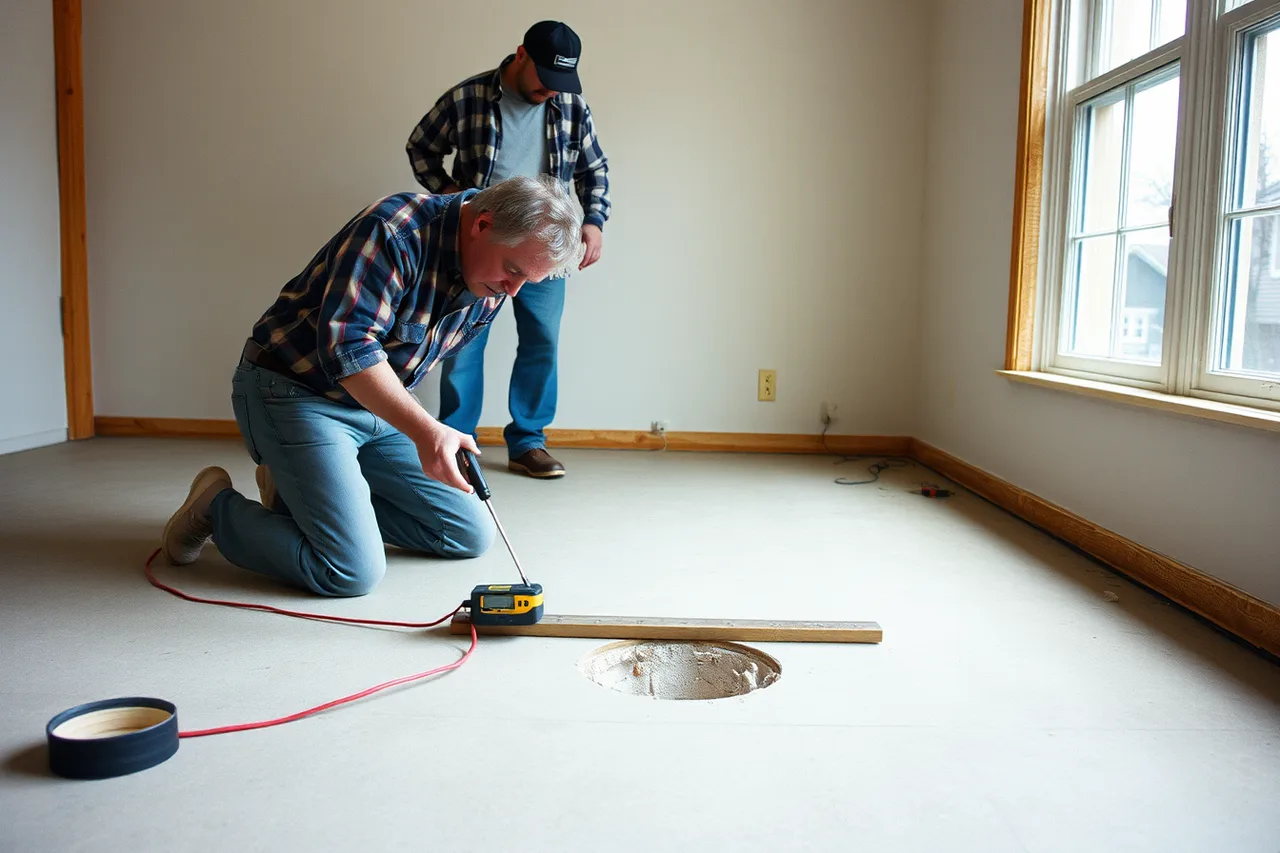
Take the readings in front of them. Explain that the subfloor has to meet the flatness and moisture limits in the manufacturer's installation instructions or the warranty does not stand. Show them the straightedge on a bad spot. Customers who watch that happen stop comparing you on price alone, because they now understand there is something to compare.
Then send the quote quickly, structured so quantities and rates are visible. A quote that arrives the next day with lines a customer can check beats a cheaper quote that arrives a week later on one page.
Advertising that does not create work for you later
Every claim must be truthful and supported, including price claims, comparisons, qualifications and coverage. The Federal Trade Commission advertising guidance for small businesses states the standard plainly.
In flooring, one trap stands out: advertise an installed price without saying tear-out, disposal, preparation and transitions cost extra, and every reader outside the trade will read it as all-in.
Two sentences beside the price fix it. Say what the price includes. Say what is quoted separately and why it cannot be known until the old floor is up.
Reviews, honestly gathered
Reviews are how most homeowners choose a contractor, and how you collect them matters as much as how many you get.
Ask every customer, not just the ones you expect to be happy. Do not offer discounts, gifts, or anything else for a rating.
Disclose any connection where one exists. The Federal Trade Commission guidance on soliciting and paying for online reviews covers incentives and the selective asking many businesses do without thinking about it.
Reply to the difficult ones with what happened and what changed. That reply is read by the next customer, and it does more for you than the five-star entries above it.
Measuring a channel properly
- Count booked jobs by channel, not calls or clicks; use the source recorded on each quote or job form and reconcile it to the completed job.
- Add up everything the channel cost, including direct spend, fees, and your own estimating and driving time valued at your owner labor rate.
- Divide total channel cost by jobs the customer accepted to get cost per booked job. Compare it with the contribution earned by those jobs, calculated as job revenue minus direct job costs; divide that contribution by crew days to get contribution per crew day.
- Look at the mix as well as the cost. A channel that brings small fragmented work can be profitable per job and bad for your calendar.
- Review quarterly and change one thing at a time, so you can attribute the result.
Set a real owner labor rate by dividing the annual compensation target you assign to owner work by annual hours available for productive work; do not treat those hours as free. Estimating time is the cost owners forget. An hour driving to a measure and an hour writing a quote is a quarter of a working day, and a channel with a low booking rate consumes those hours whether or not it produces revenue.
A quarterly review of where work comes from
- List the last twenty jobs with the route each arrived by, taken from the job file rather than from memory.
- For each route, total the direct spend plus your own hours at a real rate.
- Compute cost per booked job and contribution per crew day for each route side by side.
- Mark any route whose jobs consistently fragment the calendar, even where the per-job numbers look fine.
- Check that every claim on your website, van and profiles still matches what you hold and what you sell.
- Read your last ten reviews and note anything that names the same failure twice.
- Choose one route to strengthen and one thing to stop doing, then leave the rest alone until next quarter.
Owners who run this review usually discover two things. The route they spend most on is not the route that fills the calendar, and the route that fills the calendar is the one they have been neglecting because it costs nothing.
Growth that the operation can absorb
Demand is the easy half. A business that sells more than it can install turns its best asset, reputation, into a schedule of late starts.
Before you turn up a channel, check crew days exist, and confirm the hiring and training guide has produced people who can run a job alone. Confirm the equipment and setup guide was followed far enough that a second crew is not sharing one grinder.
Then check the rest of your operating base: prices that hold under volume come from the pricing and profit guide. Your actual offer is defined in the services and packages guide.
The standard that keeps referrals coming is in the service quality guide. Anything you advertise about licensing, bonding or insurance must match what the licensing and compliance guide says you actually hold.
What to do first with a small budget
Fix the response time before you spend anything. Answer calls, return messages the same day, and get quotes out within a day of the measure. Then make sure a homeowner who searches your name finds a business that looks real: complete profile, correct hours, photographs of your own work, and a way to reach you that a person answers.
After that, invest in the routes where you already have a relationship. A retailer who trusts your crew, a builder who has seen your punch lists, and a property manager who knows your unit price will each produce more work per hour of effort than any advertisement.
Common questions
How much should a flooring contractor spend on marketing?
Enough to keep the calendar full at the price you want to charge, which is a number only your own channel measurements can produce. Start by measuring cost per booked job on what you already do.
Do photographs of finished jobs help?
Yes, and photographs of preparation help more than owners expect. A picture of a ground and patched slab explains why your quote has a line the cheaper quote does not.
Should I advertise a price per square foot?
Only with conditions and exclusions stated beside it. Otherwise you are buying calls from people expecting a different job.
Is it worth paying for lead services?
Sometimes, and measure them like any other channel: cost per booked job, contribution per crew day, and what the work does to your schedule. Shared leads often cost estimating hours out of proportion to what they book. Track lead and local-ad services such as Angi, Thumbtack, HomeAdvisor, and Nextdoor separately, recording each source's spend and booked-job count.